

Fundamental Differences Between European and American Roulette
The two roulette versions differ in three main ways: the number of pockets on the wheel, the house edge percentage, and how the numbers are arranged around the wheel. These differences directly impact a player’s chances of winning.
Number of Pockets and Zeros
The most important difference between these two games is the number of zeros on the wheel. European roulette has 37 pockets total, with numbers 1 through 36 plus a single zero. American roulette has 38 pockets, with numbers 1 through 36 plus both a single zero and a double zero.
This extra pocket on the double zero wheel changes the odds for every bet. When a player bets on a single number in European roulette, they have a 1 in 37 chance of winning. In American roulette, that same bet has a 1 in 38 chance.
The double zero appears as “00” on the American roulette wheel. It sits directly opposite the single zero. Both zeros are typically colored green to distinguish them from the red and black numbers.
House Edge Comparison
The house edge is the mathematical advantage the casino has over players. European roulette has a house edge of 2.7%. American roulette has a house edge of 5.26%.
This difference comes entirely from the extra zero pocket. The payouts for winning bets are the same in both games, but the extra pocket on American roulette wheels reduces the player’s probability of winning. A player betting $100 per spin can expect to lose $2.70 per spin on average in European roulette, compared to $5.26 per spin in American roulette.
House Edge Comparison:
- European Roulette: 2.7%
- American Roulette: 5.26%
Wheel Numbering and Layout
The roulette wheel layout differs between the two versions beyond just the number of pockets. European roulette wheels arrange numbers in a specific sequence that alternates between high and low numbers more consistently. American roulette wheels use a different number sequence.
On a European wheel, the single zero sits between numbers 26 and 32. On an American wheel, the single zero sits between numbers 2 and 28, while the double zero sits between numbers 1 and 27. The arrangement affects which numbers sit next to each other, though it doesn’t change the odds of any particular number hitting.
Both wheel layouts alternate red and black pockets around the wheel. The goal of both arrangements is to distribute odd, even, high, and low numbers as evenly as possible around the wheel.

Roulette Table Layouts and Betting Areas
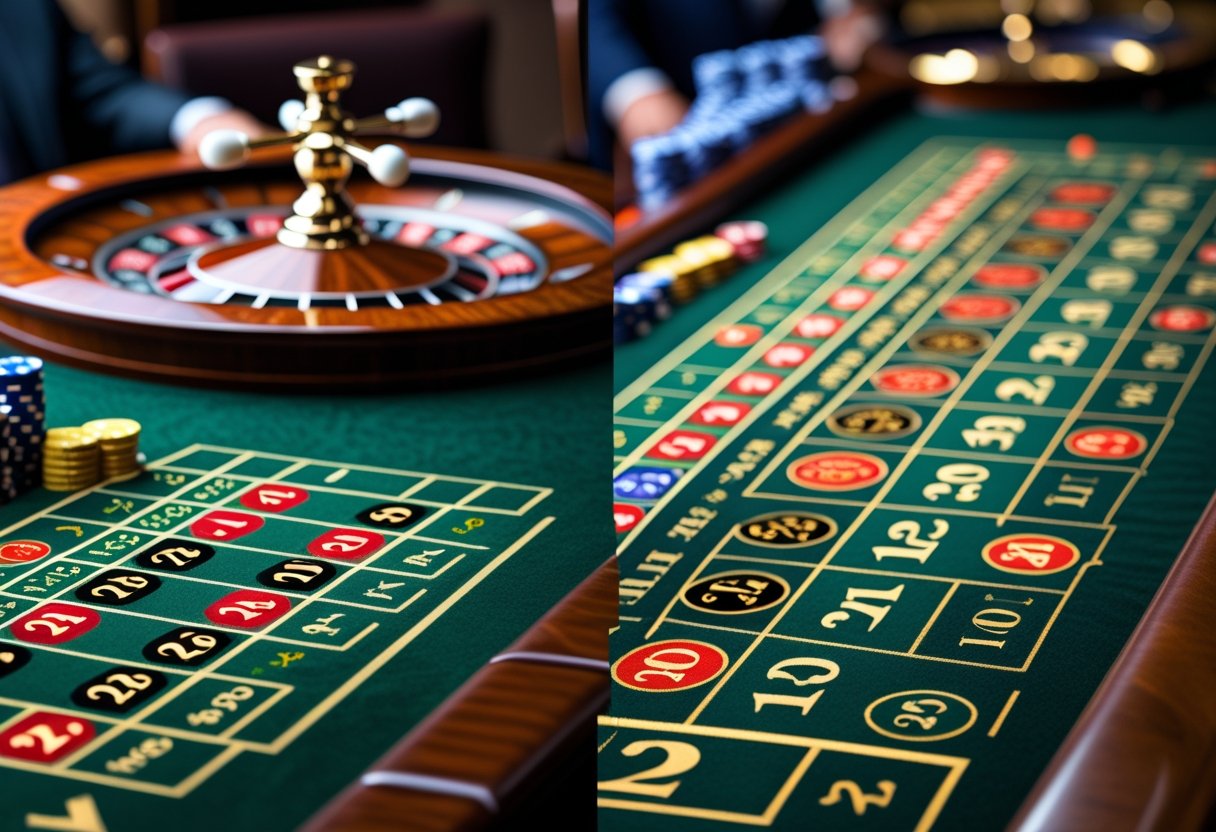
Both roulette variants use similar table designs, but the American version includes an extra betting position for the double zero. The betting grid remains mostly identical, though the placement of certain sections differs slightly between the two games.
Visual Differences in Layouts
The European roulette table features a single green zero at the top of the betting grid. The numbers 1 through 36 are arranged in three columns below it, with red and black alternating throughout.
American roulette adds a second green pocket marked “00” next to the zero. This creates an additional row at the top of the betting layout. The 00 sits in its own dedicated space, which changes the visual balance of the table.
Both layouts display the same outside betting areas for red/black, odd/even, and high/low wagers. These sections typically appear on the sides or bottom of the number grid. The positioning of these areas can vary between casinos, but the betting options remain consistent across both variants.
Betting Sections on Each Table
The main betting grid allows players to place chips directly on individual numbers or groups of numbers. Inside bets include straight-up wagers on single numbers, splits between two adjacent numbers, and street bets covering three numbers in a row.
Outside betting areas offer broader coverage with lower payouts. Players can bet on red or black, odd or even, or ranges like 1-18 and 19-36. Column bets and dozen bets cover 12 numbers at once.
American roulette includes one unique bet called the basket or five-number bet. This wager covers 0, 00, 1, 2, and 3 in a single bet. The European table has no equivalent option since it lacks the double zero pocket needed for this combination.
Types of Bets Unique to Each Version
American and European roulette variants offer different betting options beyond the standard inside and outside bets. American roulette features a unique five-number bet, while European roulette provides access to call bets through the racetrack layout.
American Five-Number Bet
The American five-number bet, also called the Basket bet, is exclusive to American roulette. This bet covers 0, 00, 1, 2, and 3 in a single wager. Players place their chip on the line where all five numbers meet.
The Basket bet pays 6 to 1 when it wins. However, this bet has the worst house edge of any roulette bet at 7.89%. This is significantly higher than the standard 5.26% house edge found on other American roulette bets.
Most experienced players avoid the five-number bet. The poor odds make it an unfavorable choice compared to other betting options on the table.
European Call Bets and Racetrack
European roulette tables often include a racetrack section that displays call bets. These special bets cover specific sections of the wheel based on number positions rather than table layout. Call bets include Voisins du Zero (neighbors of zero), Tiers du Cylindre (third of the wheel), and Orphelins (orphans).
The racetrack makes it easier to place these multi-chip bets quickly. Each call bet covers a different group of numbers that sit together on the physical wheel. Players can also make neighbor bets, which cover a number and the numbers directly adjacent to it on the wheel.
These betting options are not available in American roulette. The racetrack feature gives European roulette more variety in betting strategies beyond basic inside and outside bets.

Roulette Odds and Payouts
The payout structure remains identical in both American and European roulette, but the odds of winning differ because of the extra pocket on the American wheel. This variation in odds directly impacts the house edge and a player’s long-term results.
Differences in Bet Odds
European roulette offers better odds than American roulette for every type of bet. The European wheel contains 37 pockets (numbers 1-36 plus a single zero), while the American wheel has 38 pockets (numbers 1-36 plus both a zero and double zero).
For a straight-up bet on a single number, European roulette gives players odds of 36 to 1 of winning. American roulette drops those odds to 37 to 1 because of the additional pocket.
Even money bets like red/black or odd/even show the same pattern. In European roulette, these bets win 48.6% of the time. American roulette reduces this to 47.4%.
The house edge tells the complete story. European roulette maintains a house edge of 2.64%, while American roulette jumps to 5.26%. American players lose twice as much money over time when compared to European players making identical bets.
Comparison of Roulette Payouts
Both versions pay winners using the same ratios regardless of the different odds. A straight-up bet pays 35 to 1 in both games. A split bet pays 17 to 1. A street bet pays 11 to 1.
| Bet Type | European Payout | American Payout |
|---|---|---|
| Straight-up | 35:1 | 35:1 |
| Split | 17:1 | 17:1 |
| Street | 11:1 | 11:1 |
| Corner | 8:1 | 8:1 |
| Six Line | 5:1 | 5:1 |
| Even Money | 1:1 | 1:1 |
Even money bets include red/black, odd/even, and 1-18/19-36. These all pay 1 to 1 in both games.
The identical roulette payout structure creates a disadvantage for American players. They receive the same winnings despite facing worse odds on every spin. This combination of lower winning probability and unchanged roulette payouts explains why European roulette is the smarter choice for players seeking better value.
Special Rules in European and French Roulette
French roulette includes two special rules that lower the house edge on even-money bets: La Partage and En Prison. These rules only apply when the ball lands on zero and can cut the casino’s advantage in half.
La Partage Rule
The La Partage rule applies to even-money bets like red/black, odd/even, and high/low. When the ball lands on zero, players lose only half of their even-money bet instead of the entire amount. The other half returns to the player automatically.
This rule reduces the house edge from 2.7% to 1.35% on these specific bets. That makes French roulette the most player-friendly version of the game.
The rule is straightforward with no extra decisions required. Players simply get half their stake back when zero hits. Most online and land-based casinos that offer French roulette include this rule by default.
En Prison Rule
The En Prison rule offers an alternative to La Partage at some French roulette tables. When zero hits on an even-money bet, the wager becomes “imprisoned” for the next spin instead of losing half immediately.
If the imprisoned bet wins on the following spin, the player gets the original stake back without any winnings. If it loses, the entire bet goes to the house. If zero hits again, the bet typically stays imprisoned for another round.
This rule also reduces the house edge to 1.35%, making it mathematically equivalent to La Partage. The main difference is timing. Players must wait an extra spin to see the outcome of their imprisoned bet. Some players prefer La Partage for its simplicity, while others like the second chance that En Prison provides.
Impact on Bankroll and Strategies
The structural differences between European and American roulette create measurable effects on how long funds last and which betting approaches work best. The house edge gap of roughly 2.5 percentage points changes how players should think about session length and wager sizing.
Bankroll Management Principles
European roulette’s 2.7% house edge means a bankroll typically lasts longer than with American roulette’s 5.26% edge. For every 100 spins at $10 per spin, a player can expect to lose approximately $27 on European wheels versus $53 on American wheels.
This difference becomes more pronounced over extended sessions. Players working with limited funds should account for the faster bankroll decline when playing American roulette.
Setting a loss limit before starting helps prevent overspending in either version. Many experienced players divide their bankroll into units and risk only 1-2% per spin to extend playing time. The lower house edge in European roulette makes flat betting more sustainable, while American roulette requires tighter budget controls to maintain the same session length.
Typical Roulette Strategies for Each Version
Common roulette strategies include the Martingale, where players double bets after losses, and the Fibonacci, which follows a mathematical sequence. These systems work identically on both wheel types but perform differently due to house edge variations.
European roulette better accommodates progression systems because the lower house edge gives more room for recovery. The American version’s extra zero pocket increases the likelihood of hitting table limits before recovering losses.
Even-money bets on red/black or odd/even form the foundation of most strategies. European tables sometimes offer La Partage or En Prison rules that return half the wager or hold it for another spin when zero hits, effectively cutting the house edge to 1.35% on these bets. American roulette rarely includes these player-friendly modifications.
Players using any system should recognize that no strategy eliminates the house advantage. The mathematical edge remains constant regardless of betting patterns.
Playing Roulette Online: Which Version to Choose?
Online casinos typically offer both European and American roulette, allowing players to select the version that matches their preferences. The choice often comes down to game availability and individual priorities around house edge and gameplay style.
Availability of Wheel Types Online
Most online casinos provide European roulette as their primary format. This version appears more frequently because of its lower house edge and broader international appeal. American roulette is still widely available but often sits alongside the European version rather than replacing it.
Digital platforms make it easy to switch between different types of roulette within the same session. Players can test both formats without changing venues. Live dealer games expand these options further by offering real-time spins with professional croupiers, often featuring both wheel types across multiple tables.
Some platforms also include variations like French roulette, which uses the single-zero wheel with additional rules such as La Partage. The variety in online roulette means players can compare formats directly and decide which structure fits their session goals.
Choosing the Best Game for You
European roulette suits players who want a lower house edge and longer session duration with the same bankroll. The 2.7% house advantage creates better long-term odds than the American version, especially for those using even-money bets.
American roulette may appeal to players who prefer faster-paced action or want access to the five-number bet, which only exists on double-zero wheels. The higher house edge means bankrolls deplete faster over extended play, but some players prefer the traditional American format for familiarity.
Testing both versions in free-play mode helps identify which layout and pace feel more comfortable. Players focused on maximizing session length typically choose European wheels, while those prioritizing variety or specific betting options may explore American formats.
Frequently Asked Questions
The two versions of roulette differ primarily in wheel design, with European featuring 37 pockets and a 2.7% house edge, while American has 38 pockets and a 5.26% house edge. These structural differences affect odds, payouts, and player strategy in measurable ways.
What are the main differences in wheel layout between European and American roulette?
The European roulette wheel contains 37 pockets numbered 1 through 36, plus a single green zero. The American roulette wheel has 38 pockets with the same 1 through 36 numbering, but includes both a single zero and a double zero.
This extra pocket on the American wheel is marked as “00” and sits directly across from the single zero. The number arrangement around the wheel also differs between the two versions, with each using its own specific sequence.
The additional double zero pocket is the most important structural difference between the two games. It changes the math behind every bet placed on the table.
How do the odds and payouts compare between European and American roulette?
Both versions pay identical amounts for winning bets. A straight-up bet on a single number pays 35 to 1 in both games, and outside bets like red or black pay even money.
The odds of winning differ because of the extra pocket on the American wheel. In European roulette, the chance of hitting a specific number is 1 in 37, or about 2.7%. In American roulette, that same bet has odds of 1 in 38, or about 2.63%.
For outside bets like red or black, European roulette gives players 18 winning pockets out of 37 total. American roulette offers the same 18 winning pockets but out of 38 total, reducing the probability of success.
The five-number bet in American roulette covers 0, 00, 1, 2, and 3. This bet carries a house edge of 7.89%, making it the worst bet available in either version of the game.
What are the strategic implications of playing European versus American roulette?
Players face better long-term results in European roulette due to the lower house edge. Every bet type benefits from the absence of the double zero pocket.
Bankroll management becomes more important in American roulette because the higher house edge means faster expected losses over time. Players need larger bankrolls to sustain the same length of play.
Some European roulette games offer the “en prison” or “la partage” rules. These rules return half of even-money bets or allow them to remain for another spin when the ball lands on zero, further reducing the house edge to 1.35% on those specific bets.
Betting systems like the Martingale or Fibonacci work identically in both games but produce better results in European roulette. The lower house edge means these systems can withstand longer losing streaks before depleting a bankroll.
How do table layouts vary between European and American roulette games?
Both table layouts display the numbers 1 through 36 in a grid of three columns and twelve rows. The main betting area looks nearly identical between the two versions.
The American table includes an additional betting spot for the double zero at the top of the layout. It also features a unique five-number bet area that covers 0, 00, 1, 2, and 3.
European tables often include special betting areas for “announced bets” or “call bets” like Voisins du Zero, Tiers du Cylindre, and Orphelins. These bets cover specific sections of the wheel and are less common on American tables.
The racetrack betting area appears on many European tables. This oval-shaped section mirrors the wheel’s number sequence and makes it easier to place neighbor bets and other wheel-section wagers.
What are the house edges for European and American roulette?
European roulette has a house edge of 2.7% on all standard bets. This percentage comes from the single zero pocket, which creates one losing outcome beyond the 36 numbered pockets.
American roulette carries a house edge of 5.26% on most bets. The double zero pocket adds a second non-paying outcome, nearly doubling the casino’s advantage compared to the European version.
The five-number bet in American roulette has a house edge of 7.89%. No other standard bet in either version approaches this level of disadvantage for the player.
When European roulette includes the “en prison” or “la partage” rules, the house edge on even-money bets drops to 1.35%. This makes those specific bets the most favorable option available in either game variant.
Why might a player choose European roulette over American roulette?
The lower house edge provides the most compelling reason to choose European roulette. Players lose money at a slower rate, which extends playing time and increases the chance of short-term winning sessions.
European roulette offers better value for every dollar wagered. For every $100 bet in European roulette, the expected loss is $2.70, compared to $5.26 in American roulette.
Players who use betting systems benefit more from European roulette’s favorable odds. The reduced house edge gives these systems more room to work before variance depletes the bankroll.
Some players prefer European roulette for its traditional appeal and additional betting options. The announced bets and racetrack layout add variety that experienced players find engaging.